Outreach
Last updated: Aug 17, 2026
While I don't consider myself a very chatty person in my everyday life, one of the activity that I prefer the most is reaching out to people and talk about evolution and biology. The expression on people's face when they are truly enjoying (and understanding) science is priceless, and never fails to move me.
To me, science communication and outreach are ways to bring research closer to society, making it accessible, understandable and, above all, a tool that everyone can use. Giving people the ability to navigate the vast ocean of knowledge that is produced every day, is something that we, as scientists, need to integrate more into our work. After all, what is the purpose of research if it stays locked away in our labs, and can't be used by everyone?
To me, science communication and outreach are ways to bring research closer to society, making it accessible, understandable and, above all, a tool that everyone can use. Giving people the ability to navigate the vast ocean of knowledge that is produced every day, is something that we, as scientists, need to integrate more into our work. After all, what is the purpose of research if it stays locked away in our labs, and can't be used by everyone?
Outlook
BioPills
All this said, in 2017 I engaged with BioPills, an Italian science-communication project that wants to communicate the beauty of life sciences in an effective mannner but without forgetting factual accuracy. At the moment, I am the chief editor of the "Environment and Nature" section of the website. I am also in charge of organizing hikings in different Italian natural settings, in order to let people escape from the urban routine while directly immersing themselves in field-based learning of biology.
Unfortunatly, the website is currently only in Italian, but if you are interested in learning more about it, don't esistate to get in touch!
Unfortunatly, the website is currently only in Italian, but if you are interested in learning more about it, don't esistate to get in touch!

Web articles
One of the main activity I've been carrying out with BioPills is the writing and publication of outreach articles on our website. Over the years, I dealt with many subjects, ranging from zoology to ecology, and from book reviews to interviews. You can find all the articles I published by visiting my account page on BioPills.
See a list of selected articles
- A cena con il dinosauro – Edward Dolnick (traduzione di Alessandra Neve).
2025. Outreach article. - I segreti dei funghi – Ginevra Picoco e Lorenzo Cocchi.
2025. Outreach article. - Paleoarte: l'unione tra arte e scienza.
2025. Outreach article. - Verso la sintesi del genoma umano.
2025. Outreach article. - Un'impronta digitale di Neandertal dalla Spagna.
2025. Outreach article. - Scoprire una nuova specie nel mare dietro casa: il caso di Steromphala federicii.
2025. Outreach article. - Miriade. La microscopica moltitudine – Marco Colombo.
2024. Book review. - Mycosium: il simposio divulgativo di micologia.
2024. Interview. - The tale of Tal – Gianpaolo di Silvestro e Luca Vergerio.
2023. Book review. - Correre tutti i rischi. Lettere sull’avventura della ricerca – Charles Darwin.
2021. Book review. - Sbiancamento dei coralli: cause e conseguenze.
2020. Outreach article. - Sbiancamento dei coralli: cause e conseguenze.
2020. Outreach article. - Biodiversità: una ricchezza inestimabile.
2019. Outreach article. - Ragno violino (Loxosceles rufescens).
2019. Outreach article. - Malmignatta (Latrodectus tredecimguttatus).
2019. Outreach article. - Mantide orchidea (Hymenopus coronatus).
2019. Outreach article. - CBD: la Convenzione sulla Diversità Biologica.
2019. Outreach article. - Mimetismo: quando l'evoluzione diventa arte.
2019. Outreach article. - Fauna di Ediacara: un esperimento fallito?.
2019. Outreach article. - La medusa immortale (Turritopsis nutricola).
2018. Outreach article. - Lo strano caso delle rane deformi.
2018. Outreach article.
Webinars
With BioPills I also collaborated in organizing live webinars dealing with various biological topics. My role was primarly to moderate the webinars, by introducing the speakers and topics, and chairing the discussion with the audience. You can find all the webinars hosted by BioPills on the YouTube channel.
One of the webinar series that I care about the most, is the one dedicated to PhD students and (very) early career researchers, where I tried to give them the chance to talk about their research in a friendly environment, away from the pressure of lab meetings and conferences. The series, called "Young Scientists @BioPills – Giovani voci della ricerca" (2026), consists (at the moment) of four webinars held by four Italian PhD students:
See the list of webinars I was involved in
- Il cavallo non esiste: classificare la vita, tra passato, presente e futuro.
2026. Speaker: Luca Maria Munaron - Organismi marini biofiltratori: dall'ecologia agli studi sul campo.
2023. Speaker: Martina Capriotti - La natura che affascina: biomimesi, sostenibilità e innovazione.
2022. Speakers: Stefano Roccio, Gabriele Greco - Tra social network e superorganismi: cosa ci insegnano i più sociali tra gli insetti?.
2022. Speaker: Donato Grasso (recording available under request) - Ragni e dintorni: meraviglie e segreti del mondo aracnologico.
2022. Speaker: Filippo Castellucci - Epigenetica ed evoluzione: un incontro possibile?.
2022. Speaker: Mauro Mandrioli - Tra DNA e specie a rischio.
2021. Speakers: Giorgio Bertorelle, Victor H. Muñoz Mora, Nicola Raulli (recording not available) - La nuova rivoluzione verde: un incontro tra genomica e agricoltura.
2021. Speaker: Mauro Mandrioli (recording available under request) - DNA barcoding: un codice a barre per ogni specie vivente.
2021. Speaker: Maurizio Casiraghi - Aspettando il Darwin Day.
2021. Speaker: Guido Barbujani (recording available under request) - Insetti commestibili: dalla preistoria al COVID-19.
2020. Speakers: Giulia Maffei, Giulia Tacchini - Un mare di microplastiche: combattere una minaccia invisbile tra immersioni e ricerche scietifiche.
2020. Speaker: Martina Capriotti - Un mare di microplastiche: combattere una minaccia invisbile tra immersioni e ricerche scietifiche.
2020. Speaker: Martina Capriotti
One of the webinar series that I care about the most, is the one dedicated to PhD students and (very) early career researchers, where I tried to give them the chance to talk about their research in a friendly environment, away from the pressure of lab meetings and conferences. The series, called "Young Scientists @BioPills – Giovani voci della ricerca" (2026), consists (at the moment) of four webinars held by four Italian PhD students:
- "Alla scoperta di bradipi, formichieri e armadilli, tra paleontologia e biologia" [All about sloths, anteaters and armadillos: a biological and paleontological perspective]. By Mattia Paparo, PhD student at the Universidade Federal do Rio Grande do Sul (Brasil).
- "Organi complessi in evoluzione: lezioni sul sistema digerente dagli echinodermi" [Evolution of complex organs: lessons on the digestive system from echinoderms]. By Lorenza Maria Rusciano, PhD student at the Stazione Zoologica Anton Dohrn in Naples (Italy).
- "Lost in pollination: impatti invisibili sulle api" [Lost in pollinations: invisible threats to the bees]. By Manuel Roppo Valente, post-graduate reserachers at the Università degli Studi di Torino (Italy).
- "Il mondo invisibile che nutre il Pianeta: microbi e futuro dell'agricoltura" [Feeding our Planet: microbes and the future of agricolture]. By Beatruce Farda, (former) PhD student at the Università degli Studi dell'Aquila (Italy).
Other activities
Every now and then I also participate in side activities which involve the collaboration between BioPills and other scientific initiatives.
For example, following SMBE 2023 in Ferrara, Italy, I established a collaboration with "In the Light of Evolution" (LoE), a scientific outreach project by the Swiss Bioinformatics Institute, the Swiss National Science Foundation, and the University of Lausanne. Specifically, the objective was to translate the LoE website into Italian (take a look at the "Banana split story") and hopefully to jointly organize outreach activities.
Also, for over 2 years, BioPills has provided articles to the "Giornale dei Biologi" on a monthly basis. I took care of reviewing articles dealing with zoology, ecology, and related subjects, and I also wrote my own piece: "Abbiamo ancora bisogno di parlare di fossili viventi?" (which may translate in something like "Is there any use in discussing the living fossil concept?").
For example, following SMBE 2023 in Ferrara, Italy, I established a collaboration with "In the Light of Evolution" (LoE), a scientific outreach project by the Swiss Bioinformatics Institute, the Swiss National Science Foundation, and the University of Lausanne. Specifically, the objective was to translate the LoE website into Italian (take a look at the "Banana split story") and hopefully to jointly organize outreach activities.
Also, for over 2 years, BioPills has provided articles to the "Giornale dei Biologi" on a monthly basis. I took care of reviewing articles dealing with zoology, ecology, and related subjects, and I also wrote my own piece: "Abbiamo ancora bisogno di parlare di fossili viventi?" (which may translate in something like "Is there any use in discussing the living fossil concept?").
WWA: Wood Wide Ants
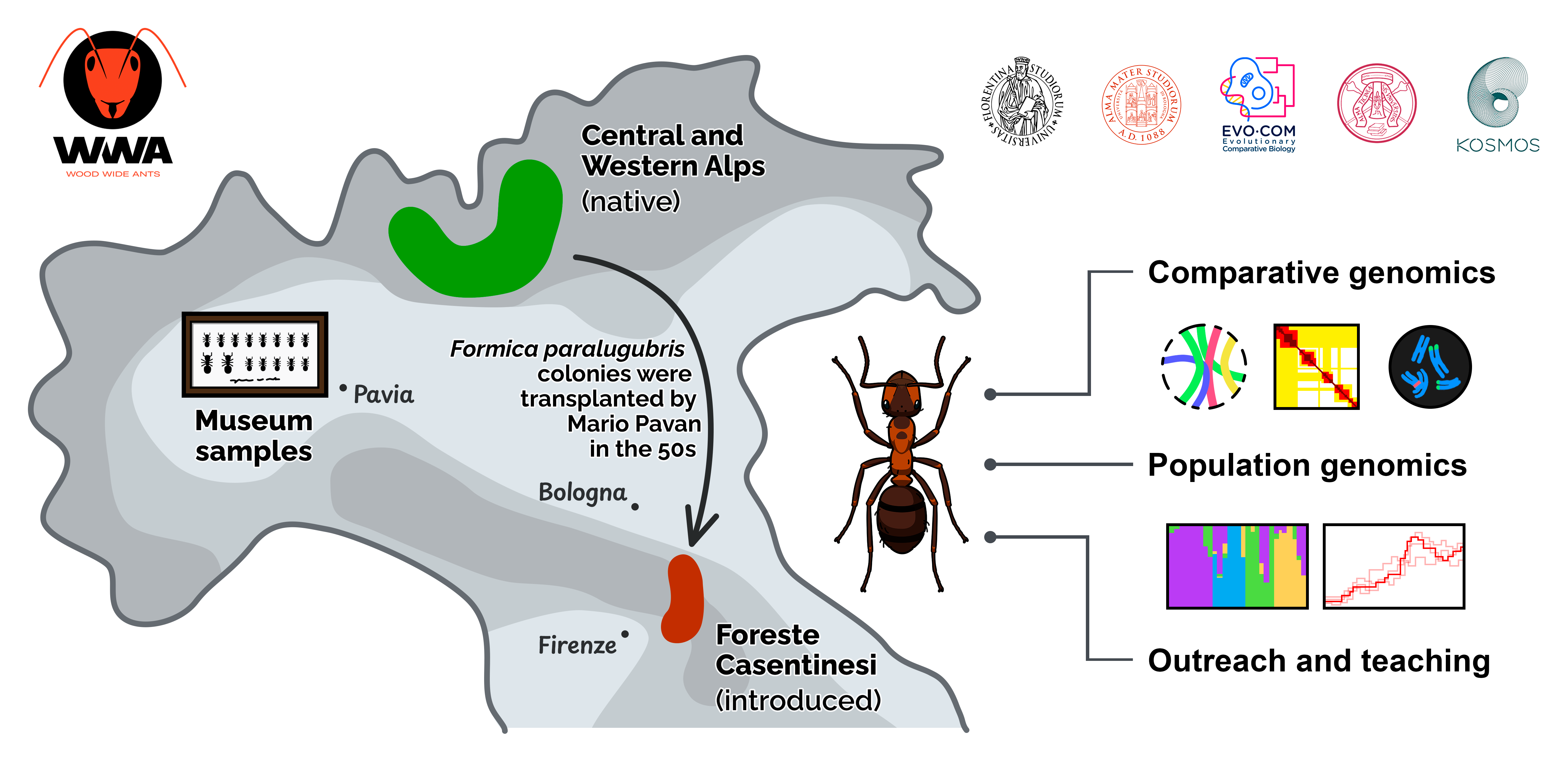
Wood Wide Ants (WWA) is a research project that aims to produce a high-quality chromosome-level genome of Formica paralugubris, an endemic Italian species of wood ants. The project outlook can be accessed on the project dedicated website.
At its core, and besides research, WWA promotes an extensive science communication and education activity, which is carried out by prof Fabrizio Ghiselli, Enrico Strada, and myself. The main objective is to bring the concepts of genomics, biodiversity, citizen science, and entomology to the general public and schools, by engaging in public events and educational projects.
WWA, including its outreach commitment, is partially funded by ERGA-BGE. A featured article can be accessed on the ERGA website.
At its core, and besides research, WWA promotes an extensive science communication and education activity, which is carried out by prof Fabrizio Ghiselli, Enrico Strada, and myself. The main objective is to bring the concepts of genomics, biodiversity, citizen science, and entomology to the general public and schools, by engaging in public events and educational projects.
WWA, including its outreach commitment, is partially funded by ERGA-BGE. A featured article can be accessed on the ERGA website.