
Research
Last updated: Aug 17, 2026
Here you can find the description of the research lines I am currently working on, alongside selected papers and key collaborators for each. Feel free to get in touch for anything you'd like to discuss!
Outlook
Evolution of phototransduction in early animals
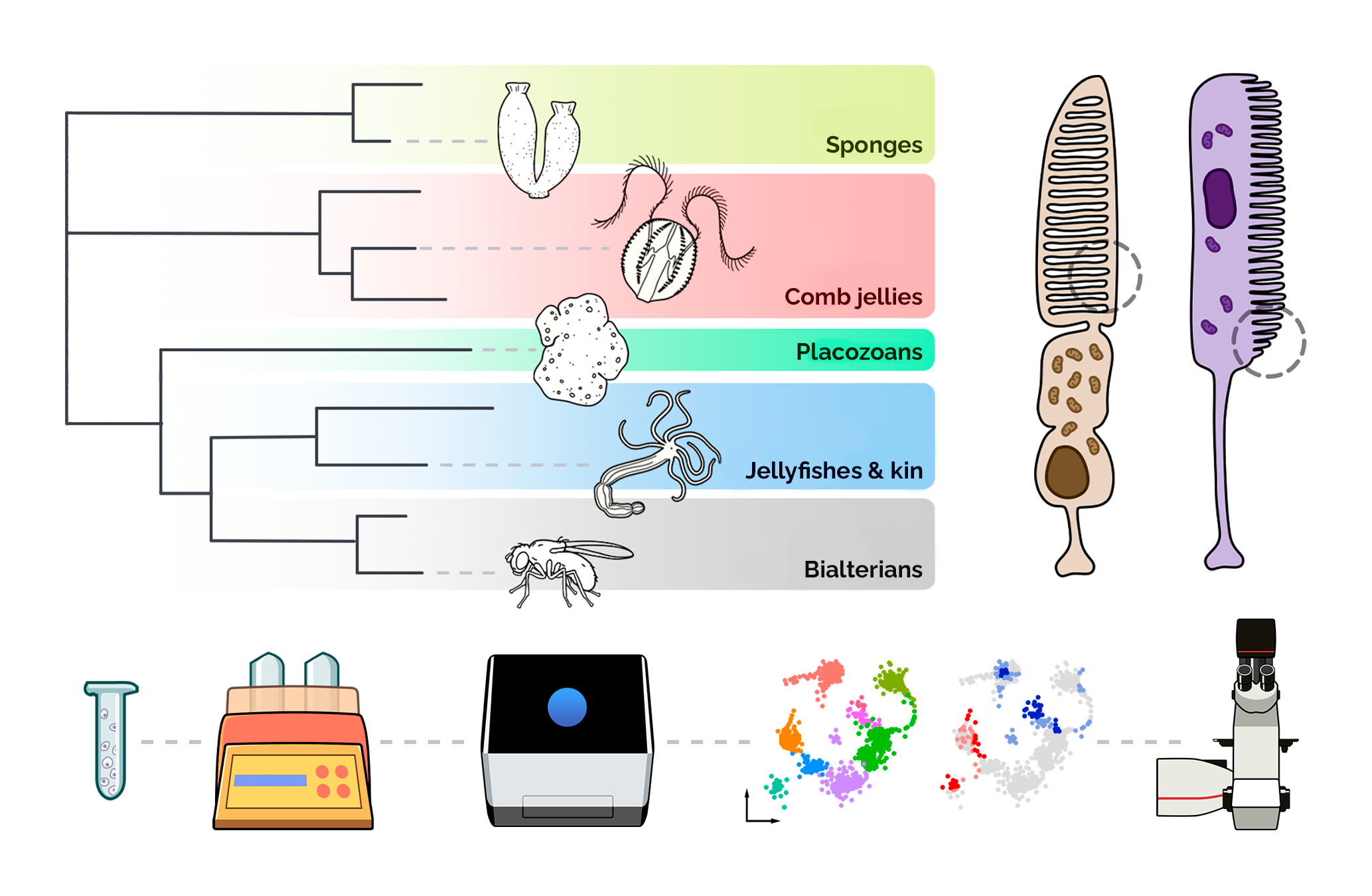
Light detection is a fundamental process in animals: it regulates physiology and behaviour, synchronises daily light/dark cycles, and enables image formation. In most lineages, this process is initiated by opsins, a group of photosensitive G protein-coupled receptors (GPCRs) that are able to convert light into electric signals. While opsins have been described in nearly all metazoan phyla, little is known about the distribution and expression of the phototransduction genes that work with them, particularly in non-bilaterian animals.
How has the photostransduction cascade evolved? What is its degree of conservation among animal phyla? What can non-bilaterian animals tell us about the emergence of light detection in animals?
In this research line, I am leveraging the latest advancements in single-cell RNA-sequecing, comparative genomics, and fluorescent microscopy to tackle these open questions.
Main collaborators
- Prof. Roberto Feuda (University of Bologna; University of Leicester) and prof. Davide Pisani (University of Bristol).
- Dongfeng Wang (postdoc; University of Leicester); Christopher Kay (postdoc; University of Bristol); Clifton Lewis (postdoc; University of Galway); and Matthew Goulty (postdoc; University of Leuven).
- Ruman Kalid (PhD student; University of Leicester) and DaeNia La Rodé (PhD student; University of Leicester).
Sex determination and germline biology of bivalves
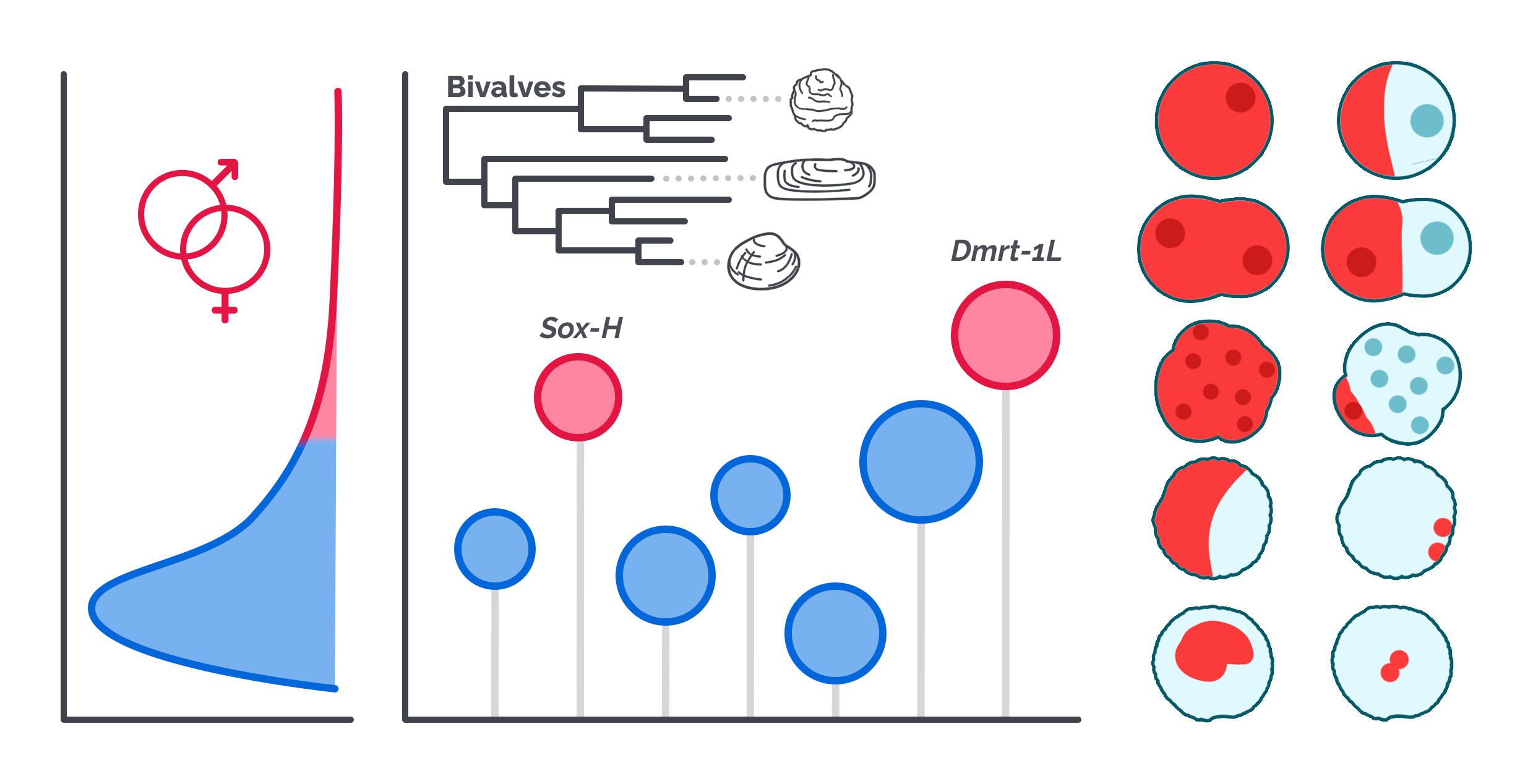
Bivalves are among the most profitable resources in aquacolture, yet many aspects of their biology are still understudied. Particularly, bivalves may serve as impactful models to study the evolution of sex determination and reproductive processes, as they exhibit many different sexual systems. One key aspect of bivalve biology is the presence in several species of the doubly uniparental inheritance (DUI) of mitochondria, where both female and male mitochondria are transmitted uniparentally to the female and male offspring, respectively.
How is sex determined in different bivalve species? What is the interplay between sex determination, germline formation, and DUI? How have genomes adapted to these processes?
Thanks to broad scale comparative genomics studies, bulk and single-cell RNA-sequencing, and hybridization chain reaction (HCR) in bivalve embryos, I am investigating the potential role of key genes in processes such as sex determination and germline specification in bivalves, with a special focus on the Mediterranean mussel (Mytilus galloprovincialis).
Selected papers
- Nicolini F, et al. (2026). Early embryonic transcription of Vasa in the Mediterranean mussel reveals divergent routes to germline specification in bivalves. Pre-print. doi: 10.21203/rs.3.rs-9824110/v1
- Nicolini F, et al. (2025). Comparative genomics of sex‐determination‐related genes reveals shared evolutionary patterns between bivalves and mammals, but not fruit flies. Molecular Ecology, 34(20), e70103. doi: 10.1111/mec.70103
- Iannello M, et al. (2025). New insights into mitochondrial segregation from the Doubly Uniparental Inheritance system in bivalves. BMC Biology, 23(1), 371. doi: 10.1186/s12915-025-02459-6
- Nicolini F, et al. (2023). Bivalves as emerging model systems to study the mechanisms and evolution of sex determination: a genomic point of view. Genome Biology and Evolution, 15(10), evad181. doi: 10.1093/gbe/evad181
Main collaborators
- Prof. Liliana Milani (University of Bologna); prof. Fabrizio Ghiselli (University of Bologna); prof. Sergey V Nuzhdin (University of Southern California); and Erico D'Aniello (researcher; Stazione Zoologica Anton Dohrn).
- Mariangela Iannello (former postdoc; University of Bologna) and Giovanni Piccinini (former postdoc; University of Bologna).
- Federica Salatiello (PhD student; Stazione Zoologica Anton Dohrn).
Comparative and population genomics of red wood ants
Formica paralugubris is a red wood ant native to the Italian Alps and belonging to the "rufa" group. During the Fifties, many of its nests were transplanted throughout the Italian Appennines, in Germany and even in Canada, by the entomologist Mario Pavan. He was trying to use this species as an agent of biological control towards the pine processionary, a pest of conifer woods. Althought many of the transplanted nest didn't survive, some are still thriving in today's Italian forests.
How has the genome of this species responded to the transplants, from a population genomics point of view? Is there a genetic basis of the survivor success of different nests? What are the genomic characteristics of ants of the "rufa" group?
Thanks to a wide collaboration involving many Italian universities, as well as European fundings secured from ERGA/BGE, we are now producing a high-quality reference genome for Formica paralugubris to use in comparative and population genomics studies.
To find out more about this research project, visit the Outreach section of this website, or the dedicated website.
Main collaborators
- Prof. Fabrizio Ghiselli (University of Bologna); prof. Andrea Luchetti (University of Bologna); prof. Lino Ometto (University of Pavia); prof. Giacomo Santini (University of Firenze); and prof. Liliana Milani (University of Bologna).
- Giobbe Forni (postdoc; University of Bologna); Jacopo Martelossi (postdoc; University of Ferrara); and Alberto Masoni (postdoc; University of Florence).
- Mirko Martini (PhD student; University of Bologna); Enrico Strada (University of Bologna).
Molecular evolution
Different portions of the genome evolve at different rates: this is one of the fundamental concepts of modern biology and is at the core of molecular evolutionary theory. Understading the drivers of such difference is thus pivotal to harness the tools of comparative genomics, phylogenomics, and population genetics. Accordingly, well-curated and standardized datasets of molecular resources are essential to aid reproducible and accessible research.
How is molecular and genome evolution influenced by the higher organizational levels of life, such as the phenotype? How what about the other way around, that is, how can molecules and genomes influence other life history traits?
Selected papers
- Forni G, et al. 2026. Loss, persistence and reversal of phenotypic traits. Biological Reviews. doi: 10.1002/brv.70168
- Nicolini F, et al. 2025. Comparative genomics of sex‐determination‐related genes reveals shared evolutionary patterns between bivalves and mammals, but not fruit flies. Molecular Ecology, 34(20), e70103. doi: 10.1111/mec.70103
- Forni G, et al. 2026. The elusive genomic signature of tadpole shrimps’ ancient morphology. Biology Letters, 22(3), 20250130. doi: 10.1098/rsbl.2025.0130
- Nicolini F, et al. 2023. Comparative genomics of Hox and ParaHox genes among major lineages of Branchiopoda with emphasis on tadpole shrimps. Frontiers in Ecology and Evolution, 11, 23. doi: 10.3389/fevo.2023.1046960
- Martelossi J, et al. 2023. Multiple and diversified transposon lineages contribute to early and recent bivalve genome evolution. BMC Biology, 21(1), 1-23. doi: 10.1186/s12915-023-01632-z</p>
- Iannello M, et al. 2025. New insights into mitochondrial segregation from the Doubly Uniparental Inheritance system in bivalves. BMC Biology, 23(1), 371. doi: 10.1186/s12915-025-02459-6
Main collaborators
- Prof. Andrea Luchetti (University of Bologna); prof. Fabrizio Ghiselli (University of Bologna); prof. Liliana Milani (University of Bologna).
- Giobbe Forni (postdoc; University of Bologna); Jacopo Martelossi (postdoc; University of Ferrara); Mariangela Iannello (former postdoc; University of Bologna); and Giovanni Piccinini (former postdoc; University of Bologna).